

ChopDawg ChopDawg
Fingertips fanning a deck of blank manila cards on a studio workbench under raking noon light

Services

Full-cycle app development services

Discovery, design, engineering, release, and maintenance held under one team — so the week a store review comes back or an integration breaks, there is one group of people to call.

One team from the first interview to the tenth release

ChopDawg offers app development as one continuous service rather than a set of disconnected handoffs. Discovery, design, engineering, release, and maintenance sit under one roof, which matters most when a project hits an integration problem or a store rejection three weeks before a launch date. Below is what we actually take on, in the order most projects meet it.

Where we pick up the work

A project can enter at any of these points. Most do not need all of them at once.

Product discovery and scoping

Discovery is where a project either gets cheaper or gets expensive later. We interview the people who will use the product, document what they do today, and list the systems the app has to talk to. The output is a scoped first release with the assumptions written down, not a slide deck. Take it to another team if you want to.
Native iOS and native Android builds

When an app needs the camera, sensors, background location, or tight platform integration, native is the honest answer. We build native iOS in Swift and native Android in Kotlin, following each platform's own interaction conventions instead of forcing one design across both. That means two codebases and two release schedules. It also means fewer compromises in the parts of the product users actually touch.

Cross-platform development

For products with a shared feature set and a shared backend, cross-platform development cuts build and maintenance cost without an obvious penalty to the user. We use it where it fits and drop to native modules where a platform genuinely differs, such as background tasks or unusual hardware access. The decision gets documented so a future team can see why it was made.

Web app development

Browser-based products cover a lot of ground: internal tools, customer portals, dashboards, and full consumer products that skip the app stores entirely. A web build ships faster, updates instantly, and runs anywhere with a browser. When distribution or rapid iteration matters more than a home-screen icon, we will say so instead of upselling you into mobile.

API integration and backend work

Apps are usually the visible tenth of a system. Behind them sit payment processors, CRMs, ERPs, identity providers, and industry platforms, each with its own auth model and rate limits. We design the integration layer, handle retries and failure states properly, and document what a vendor change would break. Unremarkable work that decides whether a product holds up.

Design

UX and interface design

Design at ChopDawg is scoped to the product, not to a portfolio piece. We produce flows, states, and edge cases alongside the screens, including empty states, error handling, and what happens when the network drops. Accessibility is treated as a build requirement, not a later cleanup. If your product serves a regulated industry, we design around those constraints from the first wireframe instead of retrofitting them before launch.

Release and launch

Store submission and launch support

Shipping means clearing Apple App Store review and Google Play policy checks, both of which impose privacy disclosures, account deletion requirements, and asset standards. We prepare the submission package, respond to reviewer questions, and plan the rollout. Launch day itself is quiet when the earlier phases were done properly, which is the goal.

An app that ships and then sits untouched starts breaking within a year.

OS updates change permissions and background behaviour, third-party SDKs deprecate, and store policies tighten. Maintenance is a service, not a favour called in later.

Ask about maintenance
Long-term support and privacy

App maintenance and long-term support

Our maintenance agreements cover monitoring, crash triage, dependency updates, and a defined response window for urgent issues. We also run periodic reviews of what should be retired, so the codebase does not quietly accumulate features nobody uses and dependencies nobody trusts.

Two handheld devices lying face-down beside a coiled cable on a studio workbench, screens turned away

Privacy-first architecture

We collect the minimum data a feature requires and can explain every field to a reviewer, a customer, or a regulator. That affects authentication choices, analytics setup, and which third-party SDKs are allowed into the build. It is cheaper to design this in than to untangle it after a store complaint. Clients in finance and healthcare tend to ask about this first, and they are right to.

What we decide early

  • Which sign-in methods the product actually needs
  • Which analytics events are worth collecting at all
  • Which outside SDKs are allowed into the build
Common questions

Two things clients ask before the first call — answered plainly, then we can talk about your situation.

Do you work on existing apps built by another team?

Yes. We start with an audit of the codebase, dependencies, and release setup, then give you a written picture of what is stable and what is not. From there you can choose a scoped recovery plan or a rebuild, with the tradeoffs priced out so the decision is yours rather than ours.

Can you handle only part of a project, like design or backend work?

Frequently. Some clients come with a designer and need engineering. Others have a working app and need the integration layer rebuilt. We scope the piece you need and note how it connects to everything else, so the seams stay visible to whoever picks up the next part.

Where the work happens
Wide view across an open app studio at noon with pinned paper decks and a silhouette at a bright window

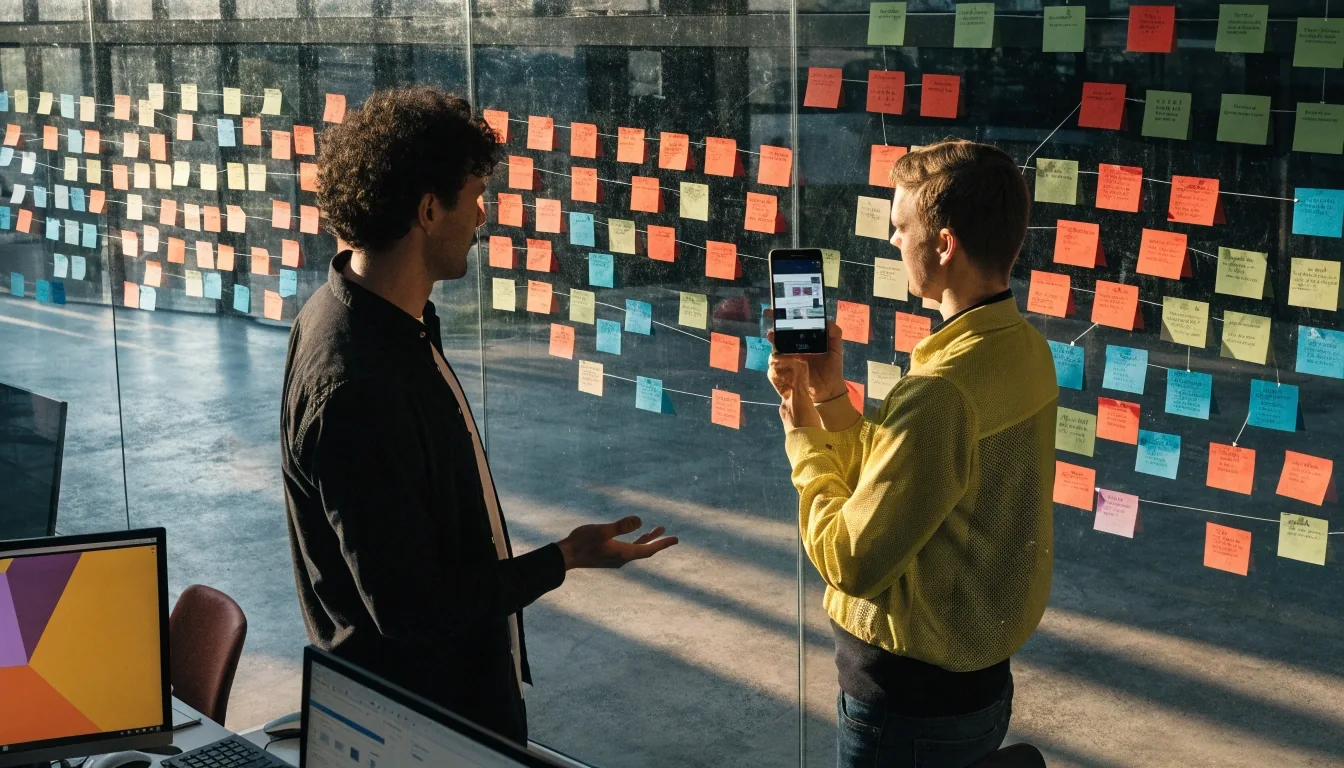
Discovery workshops, design reviews, and release planning all happen in the same room as the engineers who build. The person who scoped the feature is the person who answers for how it behaves after launch.

If you have a product in mind, or one already running that needs another set of hands, tell us what stage it is at. We will tell you plainly which of the services above apply, which do not, and what a first release would realistically contain.