
ChopDawg ChopDawg
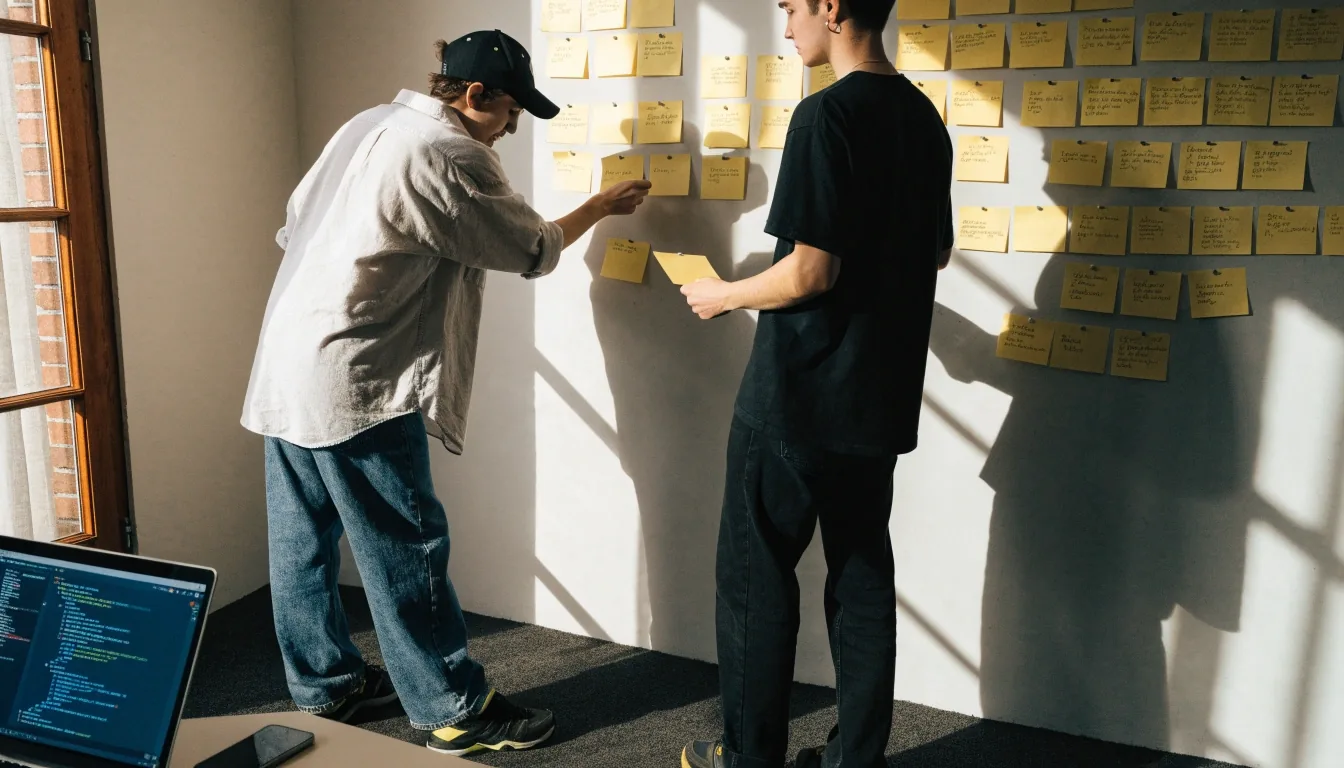
Stacked spec decks and a standing figure in a noon-lit studio workroom with cold daylight raking across a long table

How the work actually runs

How ChopDawg Takes an App From Idea to Release

Product discovery, MVP scoping, cross-platform builds, launch, and long-term app maintenance — the parts where your decisions matter most, in the order they arrive.

What is on this page

Every stage you will sit inside, including the ones that ask something of you

  1. 01 Week one: product discovery
  2. 02 Deciding what the first release has to prove
  3. 03 Architecture and integration mapping
  4. 04 Design and prototyping
  5. 05 Build sprints and what you see
  6. 06 Quality assurance and testing
  7. 07 Release phase and store review
  8. 08 After launch: iteration and maintenance

Why this page exists

Most development timelines fail in the same three places

An unclear scope. An integration nobody checked before the build started. A release phase compressed into two weeks because the calendar ran out. Our process exists to surface those problems while they are still cheap to fix, not after they land in production.

What follows is not a sales timeline. It is the actual order of work on an engagement, including the points where you have decisions to make and where we need something from you.


Where the pain lands

  • Scope drift

    Features added quietly during the build — priced as they come up instead of discovered at invoice time.

  • Integration surprises

    A vendor's API behaving differently in production than in the documentation, discovered after launch.

  • A compressed release

    Store approvals and privacy paperwork getting two weeks when they deserve a proper phase of their own.

Weeks 1–4

Week one: product discovery

The work

The first phase is conversation and documentation, not a slide deck. We talk to the people who will use the product and the people who will support it once it ships. Then we look at the systems it has to connect to — billing, CRM, an existing internal tool that has been quietly running the business for a decade.

Duration

Most discovery runs two to four weeks, depending on how many integrations are in play. Products that touch a regulated system or a legacy database tend toward the longer end; greenfield apps with a single payment provider tend toward the shorter one.

You leave with

A scoped release plan, a feature list ranked by necessity rather than by what is easy to build, and an honest list of unknowns. That last document is deliberate. An unknown flagged on day ten is a conversation; the same unknown surfaced at launch week is an incident.

The risk we are managing

Discovery is also where a project that should not be built on this budget gets said out loud. A mobile app that duplicates a workflow the team already solves in a spreadsheet is a scope conversation, not a build conversation. Better to name that here than three sprints in.

Scope before sprint one

Deciding what the first release has to prove

An MVP is not a small version of the final product. It is the smallest thing that answers one specific question: will people use this, does the workflow hold under real use, does the integration actually work in production. We write that question down explicitly, because it changes what gets built next.

Features that do not serve the question move to a later phase instead of quietly inflating the first release. This is where an MVP scope either holds or quietly doubles. We prefer it holds.

See what we build
Close detail of hands fanning a stack of note cards on a manila bench under hard noon light

Before code

Architecture and integration mapping

Before a line of production code exists, we decide how the pieces fit: data model, authentication, API contracts, and where third-party services sit in the stack. This is the phase that quietly decides whether the build stays predictable or turns into a series of surprises.

Integrations get their own document listing endpoints, authentication methods, rate limits, and failure behavior. When a vendor's API is undocumented or unstable, this is where we find out — not during the release week. It is also the phase where a no-code or low-code route sometimes becomes the reasonable choice rather than the ambitious one.

Mapped here

  • Data model and schema
  • Authentication and session handling
  • API contracts and versioning
  • Third-party service placement
  • Rate limits and failure behavior

Long before a customer sees it, this list is what keeps a build honest.

Design and prototyping run alongside the decisions they depend on

We produce flows and screens alongside the states that are easy to forget: loading, empty, error, and offline. For products with unusual interaction models, like camera-based AR, we prototype early rather than discovering the UX problem after the build.

See what we build

Build phase

Build sprints and what you see on your own phone

Two-week sprints

Engineering runs in two-week sprints with a working demo at the end of each one, not a status report. The demo is the product moving on a real device, not a slide about the product moving.

Repository access

You get repository access and a running build on a test channel from the first sprint forward. No black box between demos.

Close detail of hands cradling a smartphone at chest height with the screen angled away

Scope changes

Scope changes are welcome and priced as they come up. Silent scope creep is what turns a fixed estimate into a dispute; naming the change on the day it appears keeps the estimate meaningful.

Design reviews

Design reviews happen on a schedule. Changes get tracked in one place so nothing gets lost between rounds or quietly reintroduced later.

Macro of blank printed form pages fanned on a manila surface under raking noon light with a window-frame shadow

Quality assurance

Testing the paths that break things

Testing covers the paths users actually take, plus the ones that break things: poor connectivity, interrupted payments, permission denials, and old devices still in circulation. We test on real hardware alongside emulators, because a build that behaves on an emulator and stutters on an older phone is not ready.

Where a product handles regulated data, test cases are written against those requirements from the start rather than added at the end. Retrofitting compliance testing is where release schedules go to die.

Release phase

Submitting to the Apple App Store and Google Play is a phase of its own

Privacy disclosures, data collection forms, account deletion paths, screenshots, and review notes all get prepared here. Reviewers reject builds for reasons that have nothing to do with code quality, so we plan for at least one revision round by default rather than treating it as a setback.

You approve the release plan before anything goes live. That sign-off is on the record in the repository, so the decision stays traceable if the product grows.

After launch

Iteration and maintenance, the phase most people forget to plan for

The first month after release tells you more than the whole build did. We monitor crashes, watch how features get used in the wild, and fix what the data exposes. A feature that looked obvious on the sketch sometimes turns out to be the one nobody opens.

Maintenance continues from there: OS version updates, dependency work, store policy changes, and a queue of improvements ranked by impact rather than by whoever asked last. Products that stay healthy are the ones somebody keeps tending — that is the honest version of what long-term app maintenance looks like.

  • Crash and error monitoring

    Watching what breaks in production, not only what passed in staging.

  • OS and dependency updates

    Following platform releases so the app does not age out of the store quietly.

  • Store policy tracking

    Both stores update their review rules; the app should follow rather than react.

  • Ranked improvement queue

    Requests ordered by impact rather than by recency, so the build keeps its focus.

Your side of the table

What we need from you, and what we handle

A point of contact who can make decisions, access to the systems we need to integrate with, and timely feedback during review cycles. That is roughly it. Projects stall most often when decisions wait, so we flag blockers early rather than absorbing them quietly.

We handle vendor coordination when an integration requires it — chasing the sandbox credentials, the API keys, and the slowest email in the chain. You should not have to be the switchboard between your own team and a third-party provider.

Common questions

How long does the whole process take? +

Discovery runs two to four weeks, build sprints run in two-week increments, and release phases need their own window for store review. We give a schedule range on your project rather than a promise number that only holds when nothing surprising happens.

Can we change scope mid-build? +

Yes. Scope changes are welcome and priced as they come up. What we avoid is silent scope creep — the kind nobody admits to until the estimate has already been blown.

Cross-platform or separate builds? +

It depends on what the release has to prove. Cross-platform fits most first releases and keeps the maintenance surface small. Native builds make sense where camera, AR, or deep OS integration is central to the product — we say so during discovery, not during sprint five.

What happens to the code after launch? +

You own it from sprint one — repository access is part of the working setup. If you bring the project in-house later, the code, the integration documentation, and the environment notes come with it.

Next step

Bring us the idea. We will tell you what discovery actually looks like on it.

One call is enough to decide whether the next move is a full discovery engagement, a narrower scoping exercise, or a different route entirely. There is no pressure to answer on the first call.

ChopDawg

chopdawg.com